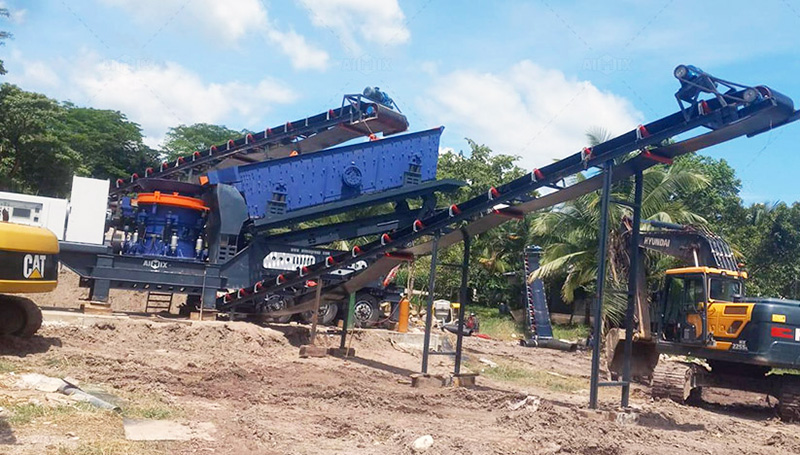
When comparing prices for granite crusher machines, it is essential to move beyond a single headline figure. The purchase price is a reflection of two fundamental, interconnected characteristics: capacity and mobility. Understanding how these core attributes influence cost will guide you toward a financially sound and operationally suitable investment. A machine’s rated output, measured in tons per hour (TPH), forms the bedrock of its valuation, as it directly correlates with the scale of its components and engineering. Simultaneously, its degree of mobility—from stationary skid-mounted units to fully mobile tracked plants—adds layers of complexity and cost that must be justified by your project requirements. A fair comparison requires evaluating machines within the same class of capacity and mobility, then scrutinizing the specific features and long-term cost implications that differentiate them.
## Capacity as the Primary Cost Driver: Understanding Output Economics
The most significant factor determining a granite crusher machine’s price is its production capacity. A machine engineered to process 50 TPH is fundamentally different from one built for 300 TPH. This disparity is not merely about size; it encompasses the robustness of the frame, the power of the drive motor or diesel engine, the dimensions and metallurgy of the wear parts (like jaw plates and concaves), and the capacity of auxiliary systems like feeders and conveyors. Higher capacity mandates heavier-duty materials and more powerful components, which incur higher manufacturing costs. Therefore, you should first clearly define your required average and peak output based on realistic project forecasts. Comparing a 150 TPH mobile jaw crusher to a 75 TPH model is not a like-for-like analysis; the price difference largely represents the substantial investment in greater volumetric throughput and the ability to complete projects faster.

Furthermore, consider the cost structure associated with capacity. A larger, higher-capacity stationary plant may have a higher initial price but a lower cost per ton over its lifetime due to economies of scale in operation. Conversely, a smaller mobile unit has a lower entry cost but might have a higher relative cost per ton if it cannot meet your demand efficiently, leading to longer project timelines. The goal is to align the machine’s capacity closely with your operational tempo to avoid both underutilization and chronic overload.
## The Mobility Premium: Analyzing the Cost of Operational Flexibility
Mobility is a feature you pay a premium to acquire. A stationary skid-mounted crusher is essentially the crushing mechanism on a transportable base. A track-mounted mobile plant, however, is an integrated system. It incorporates a heavy-duty tracked undercarriage, hydraulic systems for locomotion and setup, often a diesel-electric power train, and a control system that integrates crushing and mobility functions. This integration requires advanced engineering, more components, and rigorous testing, all of which are reflected in a higher price point.
This premium must be evaluated against the value of flexibility. The cost of a mobile crusher includes the ability to move between sites or around a large quarry with minimal downtime and without the need for transport equipment like low-loaders. It enables you to bring the crusher to the granite face, dramatically reducing truck haulage costs. If your business involves multiple job sites, contract crushing, or a quarry with dispersed deposits, this mobility premium can be quickly justified through savings in logistics and increased machine utilization. For a single, fixed-location operation, a stationary or modular skid-mounted plant often presents a more economical solution, as you are not paying for mobility features you will not use.
## Key Features that Influence Price Within Capacity and Mobility Bands
Once you are comparing machines of similar capacity and mobility, stone crusher machine price variations come down to specific features and build quality. The design of the crushing chamber significantly impacts both cost and performance. A more advanced chamber design that promotes better particle shape and higher yield may command a higher price. The level of automation is another critical differentiator. A basic machine with manual controls will cost less than one with a fully automated process control system that optimizes feed rate and monitors chamber conditions, though the latter can improve efficiency and protect the machine.
The power source is a major consideration. Machines equipped with Tier 4 Final or equivalent low-emission diesel engines are more expensive than those with older engine standards due to the advanced emissions control technology. Electric-driven crushers have a different cost profile, often with a higher initial investment but significantly lower operating costs. Other features like onboard dust suppression systems, advanced metal detection, or hybrid power options will also incrementally affect the price. It is important to distinguish between essential features for your application and optional extras that may not provide a commensurate return on investment.

## Conducting an Accurate Comparison: A Framework for Fair Evaluation
To make a trustworthy decision, you must standardize your comparison. Create a spreadsheet listing each machine under consideration. For each, document the exact specifications: engine power (kW/HP), crusher inlet size, weight, and confirmed output capacity for processing granite—not a generic material. Ensure you are comparing the same configuration, such as with or without a pre-screen or a specific conveyor length.
Most importantly, develop a Total Cost of Ownership (TCO) model for your shortlisted options. The TCO extends beyond the purchase price to include estimated costs over, for example, five years. Factor in:
Financing costs or interest if not a cash purchase.
Estimated fuel or power consumption based on engine specs and your planned hours.
Wear parts costs (liners, blow bars); request estimated consumption rates from suppliers.
Expected maintenance and service costs.
Potential resale value based on brand reputation and durability.
A machine with a slightly higher purchase price but demonstrably lower fuel consumption, longer wear part life, and higher predicted resale value will likely have a lower TCO. This comprehensive analysis moves the decision from an initial price shock to a calculated, long-term investment strategy, ensuring you select an aggregate crusher that delivers genuine value and reliability for your specific operational needs.
Comments
No comments yet. Be the first to react!