Introduction
Noise control and comfort management have become indispensable components of contemporary amusement-park planning. As attractions evolve, operators face the dual imperative of maintaining thrilling experiences while curating an environment that feels orderly, pleasant, and acoustically balanced. A park filled with uncontrolled sound—mechanical hum, crowd chatter, and intermittent high-energy surges from carnival swing ride or other ride in funfair—can quickly overwhelm guests. A well-designed acoustic strategy not only mitigates discomfort but also enhances spatial flow, emotional relaxation, and overall visitor satisfaction.
Engineering Controls for Ride Systems
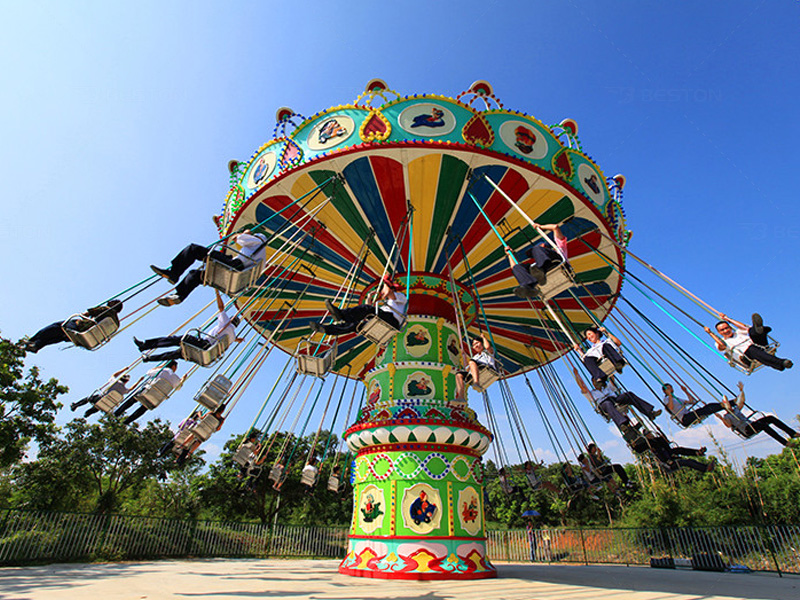
Mechanical engineering solutions offer some of the most effective interventions. Many modern attractions incorporate noise-attenuating housings around motors, fans, and gear assemblies. Precision machining and optimized lubrication schedules reduce friction-induced resonance. For large kinetic installations such as a carnival swing ride, designers can integrate vibration-dampening bushings, silent-bearing technology, and aerodynamic gondola profiling to reduce turbulence-induced whistling.
 Track-based attractions rely heavily on structural refinement. Weld smoothness, wheel hardness specification, and track steel composition all influence operating noise. When surface roughness is minimized, oscillation decreases dramatically. Manufacturers also adjust wheel assemblies—using polyurethane tread, multi-layer axle insulation, and dynamic balancing—to avoid tonal droning during continuous motion.
Spatial Planning and Acoustic Buffering
Strategic park layout plays a decisive role in noise reduction. Positioning high-intensity attractions along the perimeter pushes the strongest decibel output away from central pedestrian arteries. Vegetation belts, water features, and architectural partitions absorb or scatter sound waves. Dense shrubbery, for instance, creates natural diffraction layers that reduce propagation.
Queue zones benefit from micro-zoning principles. Instead of open serpentine layouts, operators can install semi-enclosed shelters lined with porous materials to intercept ambient noise. These structures not only improve queuing comfort but also help stabilize acoustic environments around a ride in funfair that may generate periodic bursts of mechanical sound.
Material Science and Sound Absorption
Material selection has a profound effect on acoustic comfort. Absorptive composites—fiberglass panel, perforated metal with backing wool, high-density acoustic foam, and micro-perforated plywood—can be embedded into façades, tunnel interiors, or boarding platforms. Such materials work by converting acoustic energy into negligible heat through micro-vibrations.
Ground surfaces matter as well. Pavements that incorporate rubber granules or polymer-modified asphalt lower sound reflection compared with rigid concrete. These subtle reductions accumulate across pathways and plazas, creating a noticeably calmer sound field even during peak hours.
Operational Practices and Real-Time Monitoring
Noise control is not exclusively a design task; it is also a maintenance and operations discipline. Regular inspection of bearings, fans, belts, and rotating assemblies prevents abnormal noise signatures caused by wear or imbalance. Software-based noise monitoring systems allow operators to track decibel levels continuously. When thresholds are exceeded, alerts prompt technicians to inspect machinery before failures escalate.
Ride dispatch timing can be optimized to avoid overlapping peaks. Slight adjustments to cycle intervals reduce cumulative sound layering, particularly in clusters where several attractions operate simultaneously. Coordinated scheduling is an underutilized yet highly effective noise-management tool.
Human Comfort and Psychological Acoustics
Visitor comfort extends beyond measurable decibels. Psychological acoustics evaluates how humans perceive and interpret sound. High-frequency noise often feels sharper and more irritating than low-frequency rumble, even when both measure similar amplitudes. Repetitive tonal patterns can also create perceptual fatigue.
Ambient music zones, if implemented carefully, can mask intrusive noise. However, soundtracks must be calibrated to avoid adding unnecessary auditory load. The goal is to create a coherent “sound identity” that feels intentional rather than accidental. Soft spatial sound cues—flowing water, engineered wind bells, or naturalistic soundscapes—can reduce stress and enhance immersion.
Comfort-Centric Ride Experience
Comfort management extends to the onboard experience itself. Smooth acceleration curves, refined braking algorithms, and low-vibration vehicle structures contribute to a quieter, more stable ride. When mechanical turbulence is reduced, comfort increases automatically.
For attractions like a carnival swing ride, rotational systems must operate with minimal jitter. High-quality bearings and aerodynamic seat configurations not only lower noise but also prevent micro-oscillations that can cause discomfort. Reducing unnecessary motion leads to both acoustic and ergonomic gains.
Staff Training and Communication
Employees play a role in maintaining acoustic order. Training programs can teach staff how to communicate instructions effectively without relying on excessive shouting. Microphone systems with directional speakers ensure clarity without saturating the surrounding soundscape. Staff awareness of noise-sensitive zones—family rest areas, food courts, first-aid stations—helps maintain consistent comfort levels across the park.
Integrated Comfort Management Framework
Effective noise control requires an integrated framework that merges engineering, architecture, operations, and human-focused design. Parks that treat acoustic management as a continuous lifecycle process—rather than a one-time construction task—see stronger outcomes. When noise is reduced, comfort improves. And when comfort improves, dwell time, satisfaction, and repeat visits rise accordingly.
Comprehensive acoustic planning also strengthens the park’s brand identity. Guests may not consciously notice quieter environments, but they experience them as “pleasant,” “organized,” and “relaxing.” These impressions influence overall perception more strongly than many visible design features.
Conclusion
Noise control and comfort management are structural components of modern amusement-park excellence. Through thoughtful engineering, precise spatial planning, advanced material applications, and psychologically attuned soundscaping, operators can create environments that balance exhilaration with serenity. Whether optimizing a ride in funfair, refining the mechanics of a carnival swing ride, or reshaping visitor flow, the pursuit of acoustic harmony enhances the entire park experience. It transforms chaotic sound into curated ambience and elevates comfort from a passive expectation into a deliberate design achievement.

Comments
No comments yet. Be the first to react!