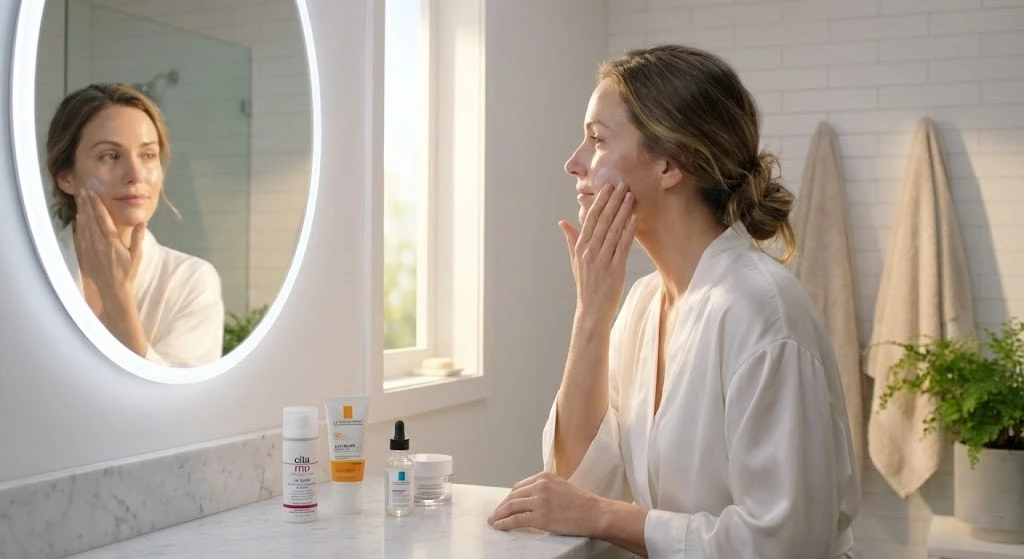
The decision required research. The procedure demanded patience. The visible lifting and tightening that emerged over subsequent months validated your investment. Now strategic maintenance determines the return on that investment.
An ultherapy treatment employs focused ultrasound energy to penetrate the skin’s foundational architecture, stimulating collagen production that continues maturing for approximately six months post-procedure. But this newly generated collagen exists within a dynamic system of environmental and lifestyle influences. Your daily decisions either preserve this tissue or accelerate its breakdown. Informed maintenance can extend visible improvements by eighteen to twenty-four months. Negligent habits can halve that duration.
This playbook details the winning strategy.
Make Sun Protection Your Absolute Priority
UV radiation remains the single most rapid environmental destroyer of collagen. Research published in the Annals of Internal Medicine revealed that study participants applying broad-spectrum SPF 30 daily demonstrated 24% less skin aging over 4.5 years versus intermittent users. After an ultherapy treatment, your skin channels significant resources into constructing fresh collagen. Solar radiation dismantles this collagen before it achieves structural maturity.
Broad-spectrum SPF 30 minimum application every morning is mandatory. This persists through all seasons, weather conditions, and indoor activities. Window-proximate environments require reapplication every two hours on exposed surfaces. Zinc oxide-based mineral formulas—such as EltaMD UV Clear or La Roche-Posay Anthelios Mineral—deliver comprehensive UVA/UVB protection while respecting sensitized post-procedure skin.
Harness Retinoids for Collagen Amplification
Among topical agents, retinoids alone possess extensive scientific literature confirming their capacity to stimulate collagen synthesis and accelerate cellular renewal. Prescription tretinoin at concentrations between 0.025% and 0.05% represents the established clinical gold standard. Over-the-counter retinol alternatives function effectively, albeit more gradually, requiring enzymatic conversion within skin tissue before activation.
Commence retinoid integration three to four weeks post-ultherapy treatment, allowing resolution of any initial sensitivity. Begin with a pea-sized measure applied to cleansed skin two to three evenings weekly, progressively advancing toward nightly use over several months. Concurrent moisturizer application minimizes irritation potential.
Should retinoids be absent from your current regimen, request tretinoin prescription from your aesthetic provider during post-treatment consultation. Most practitioners readily accommodate this request, recognizing it as among the most effective approaches for sustaining the collagen activation your ultherapy treatment generated.
Activate Peptides in Your Morning Routine
Peptides—compact amino acid sequences—function as biochemical messengers instructing skin cells to amplify collagen output. They occupy a complementary rather than competitive position relative to retinoids, operating through distinct physiological pathways. Matrixyl 3000 and Argireline demonstrate particularly impressive research credentials. The Ordinary Buffet provides accessible Matrixyl 3000, while SkinMedica TNS Advanced+ Serum represents the clinical-grade formulation frequently endorsed following energy-based modalities.
Morning application of peptide serum to cleansed skin precedes sunscreen. This establishes daily collagen signaling without the desquamation and peeling associated with retinoid therapy.
Prioritize Hydration During Recovery
Tissue remodeling proceeds actively in the months following ultherapy treatment. Dehydrated skin exhibits compromised healing kinetics and premature aging manifestations. Hyaluronic acid serums function as moisture magnets, creating the aqueous environment essential for proper collagen maturation. CeraVe Hydrating Serum and Neutrogena Hydro Boost Gel Cream offer affordable, well-crafted solutions. The Ordinary’s B5 (panthenol) formulations contribute supplementary barrier reinforcement.
Apply hyaluronic acid to freshly cleansed, still-damp skin, subsequently sealing with moisturizer. Omitting this foundational step and applying actives like retinoids to dehydrated, compromised skin amplifies sensitivity and diminishes tolerability. Reduced tolerability translates to decreased application frequency, ultimately yielding diminished collagen stimulation capacity over time.
Eliminate Collagen-Destroying Behaviors
No product regimen overcomes habits that actively degrade collagen architecture. Tobacco consumption reduces cutaneous perfusion and generates free radical species that directly assault collagen fiber integrity. Empirical studies confirm smokers experience quantifiably accelerated collagen attrition compared to age-matched non-smokers. Smoking guarantees premature dissipation of your ultherapy treatment outcomes regardless of skincare expenditure.
Dietary patterns characterized by elevated refined sugar content initiate glycation processes—sugar molecules covalently binding to collagen, inducing structural rigidity and fragility. This represents established biochemistry rather than theoretical concern. Advanced glycation end-product accumulation within skin tissue demonstrates direct correlation with accelerated aging phenotypes. Refined sugar reduction constitutes among the most impactful yet frequently overlooked approaches for preserving results following collagen-stimulating interventions.
Sleep deficiency and persistent stress elevation increase circulating cortisol concentrations, which antagonize collagen synthesis pathways. Topical preparations cannot remediate these physiological disturbances. Nocturnal hours represent when skin executes majority repair and regeneration operations. Seven to eight hours aligns with dermatophysiological research consensus.
Develop Collaborative Maintenance Protocols
Many patients approach ultherapy treatment as an isolated intervention. Clinicians view it as an ongoing therapeutic protocol. Individual treatments achieve optimal collagen response approximately three to six months post-procedure, subsequently declining as intrinsic aging processes continue unabated. Scheduled annual or semiannual maintenance sessions prevent this decline from progressing to visible regression.
Between comprehensive treatments, your provider may recommend synergistic modalities including radiofrequency microneedling, HIFU enhancement sessions, or medical-grade facial treatments strategically scheduled to support collagen remodeling phases. Request formulation of a 12-month maintenance trajectory following your initial session. Quality clinics incorporate this planning as standard care without additional consultation fees.
Your Streamlined Daily Protocol
-
Morning sequence: gentle cleanser, hyaluronic acid serum, peptide serum, moisturizer, SPF 30 or greater
-
Evening sequence: gentle cleanser, moisturizer, retinoid (initiating three nights weekly, advancing toward nightly integration)
-
Weekly assessment: examine for new photodamage indicators, modify protective behaviors accordingly, emphasize hydration preceding anticipated skin stressors such as travel or significant events
-
Monthly evaluation: assess progress under standardized lighting conditions. Establish photographic documentation the day following your ultherapy treatment for consistent monthly comparison. This practice maintains objective accountability regarding routine efficacy and optimal maintenance timing.
Your home-based care practices constitute the essential completion of your ultherapy treatment, not merely supplementary intervention. The in-office procedure establishes structural foundation. Your daily rituals determine how enduring that foundation remains.

Comments
No comments yet. Be the first to react!