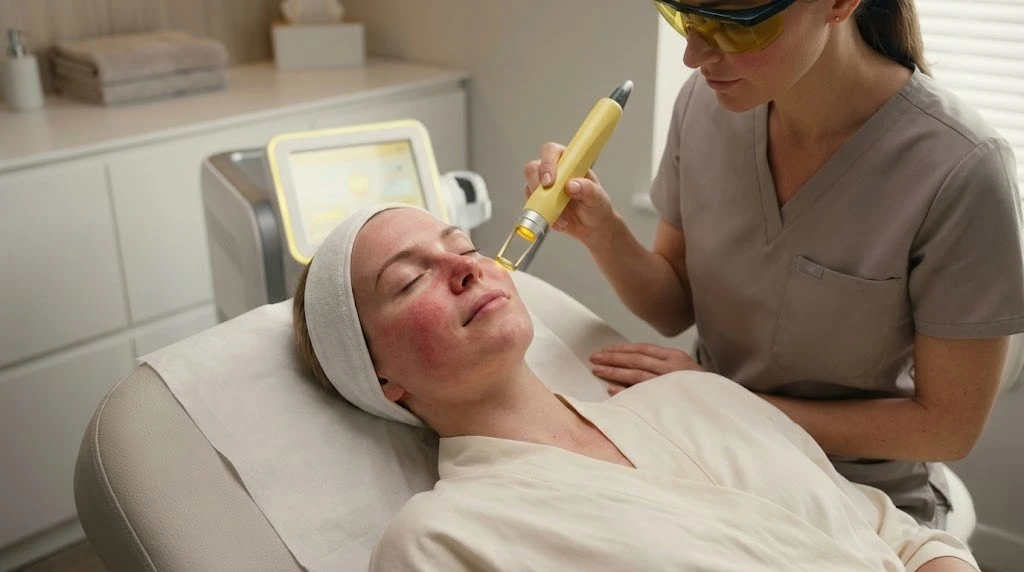
Medical technologies rarely emerge fully formed. They evolve through decades of research, clinical observation, and engineering refinement. Yellow laser treatment follows this pattern, with contemporary devices representing generations of advancement beyond early prototypes. Understanding this progression helps patients appreciate why modern yellow laser treatment at facilities like Astique Clinic offers capabilities unavailable even recently.
The journey from laboratory curiosity to clinical standard reveals how persistent scientific inquiry transforms theoretical possibilities into practical solutions for stubborn skin concerns.
Early Foundations: Understanding Light-Tissue Interaction
The story begins in the 1960s, when scientists first recognized that specific light wavelengths could selectively target biological structures. The principle of selective photothermolysis—using light energy to heat intended targets while sparing surrounding tissue—emerged from research at Harvard Medical School in the 1980s. This theoretical framework enabled rational laser design rather than trial-and-error development.
Researchers identified that hemoglobin, the oxygen-carrying protein in blood, absorbs light most strongly in the yellow-green portion of the visible spectrum. This absorption peak, around 577 nanometers, suggested optimal wavelengths for vascular targeting. Early investigators hypothesized that matching laser output to this peak could treat blood vessels with unprecedented precision.
The first experimental vascular lasers tested this hypothesis. These primitive devices proved the concept but suffered significant limitations. Pulse durations were poorly controlled, causing vessel rupture and bruising rather than selective coagulation. Cooling was absent, limiting safe energy delivery. Treatment was possible but uncomfortable, with unpredictable outcomes and significant downtime.
First-Generation Clinical Devices
By the late 1980s, commercial vascular lasers entered clinical practice. The flashlamp-pumped pulsed dye laser became the first widely available option for vascular birthmarks and facial redness. Operating at 585 or 595 nanometers, these devices established the clinical viability of laser vascular treatment.
However, first-generation technology imposed substantial burdens. The required pulse energy often caused significant purpura—bruise-like discoloration lasting one to two weeks. Treatment spots were small, making large-area treatment tedious. Repetition rates were slow, extending session duration. Patients needed multiple sessions with substantial social downtime between treatments.
Despite these limitations, results for conditions like port-wine stains proved revolutionary compared to previous options. Children who faced lifetime disfigurement could achieve dramatic improvement. This clinical success drove continued engineering investment despite device shortcomings.
Wavelength Refinement and the Yellow Shift
As understanding deepened, researchers recognized that slightly shorter wavelengths offered advantages for superficial facial vessels. The 577 nanometer “yellow” wavelength provided optimal hemoglobin absorption for the small, superficial vessels causing facial redness, while the longer “yellow-orange” wavelengths penetrated deeper for larger structures.
This nuance led to development of true yellow laser treatment devices distinct from longer-wavelength alternatives. The 578 nanometer copper vapor laser and subsequent 577-578 nanometer solid-state devices provided the specific wavelength precision that modern yellow laser treatment utilizes.
The shorter wavelength offered theoretical advantages: more efficient energy absorption by target vessels, less penetration beyond intended targets, and potentially gentler treatment. Clinical experience gradually confirmed these advantages, particularly for facial redness where vessels are relatively superficial.
Cooling Revolution: Transforming Patient Experience
Perhaps no technical advancement transformed yellow laser treatment more dramatically than integrated cooling systems. Early devices lacked this feature, requiring energy levels low enough to prevent surface damage, or accepting surface injury as treatment consequence.
Modern cooling technologies—cryogen spray, chilled sapphire contact plates, and forced cold air—protect the epidermis during treatment. This protection enables higher effective energy on target vessels than previously possible without surface damage. Simultaneously, cooling dramatically improves patient comfort, transforming treatment from ordeal to tolerable experience.
The clinical impact extends beyond comfort. Protected surface skin means minimal post-treatment redness and swelling, reducing downtime from weeks to hours. This accessibility enabled yellow laser treatment expansion from medical necessity to elective cosmetic improvement, as busy professionals could incorporate sessions without significant lifestyle disruption.
Pulse Duration Optimization
Early vascular lasers used pulse durations based on theoretical calculations of thermal relaxation time—the period required for target tissue to cool. However, clinical observation revealed that actual vessel responses varied with size and depth, suggesting need for adjustable pulse parameters.
Modern yellow laser treatment devices offer variable pulse durations, allowing customization for specific vessel characteristics. Smaller vessels respond to shorter pulses; larger structures require longer energy delivery for complete coagulation. This adjustability enables personalized treatment rather than one-size-fits-all approaches.
At Astique Clinic, practitioners utilize this flexibility to optimize outcomes across varied patient presentations. The same device treats fine diffuse redness and more prominent individual vessels through parameter adjustment, expanding treatment versatility beyond early technology capabilities.
Spot Size and Delivery System Advances
Treatment efficiency and comfort also depend on how laser energy reaches the skin. Early devices used small spot sizes requiring tedious point-by-point treatment. Modern yellow laser treatment systems offer larger spot options and sophisticated scanning mechanisms that improve speed and uniformity.
Larger spots penetrate more deeply due to optical principles, enabling effective treatment of slightly deeper vessels while maintaining surface safety. However, precision for small areas requires smaller spot capability. Contemporary devices offer range rather than fixed options, matching delivery to treatment goals.
Handpiece ergonomics and weight distribution have improved substantially. Provider fatigue during lengthy procedures affects precision; comfortable, well-balanced instruments enable consistent technique throughout sessions. These seemingly minor engineering details accumulate into meaningful outcome differences.
Computer Integration and Treatment Planning
Digital technology integration represents the latest evolution phase. Modern yellow laser treatment devices incorporate computerized control systems that enhance precision and documentation. Energy delivery becomes more consistent. Treatment patterns can be programmed for uniformity. Outcome data accumulates for continuous improvement.
Some advanced systems incorporate real-time skin response monitoring, adjusting parameters based on observed tissue reactions. This feedback loop prevents both undertreatment compromising results and overtreatment risking complications. While not yet universal, this intelligent adaptation points toward future capabilities.
Digital photography integration enables immediate pre- and post-treatment documentation, supporting patient education and outcome assessment. Treatment records become more comprehensive, supporting long-term care continuity and research contributions.
Evidence Accumulation and Indication Expansion
As technology improved, clinical applications expanded beyond original vascular birthmark treatment. Early investigators noted beneficial effects on facial redness and rosacea; systematic study confirmed and refined these observations. Post-acne erythema, photodamage-related redness, and post-procedure vascular complications emerged as additional indications.
Contemporary clinical research continues refining optimal treatment protocols. Studies establish ideal session numbers, spacing, and combination approaches. Long-term outcome data accumulates, supporting realistic patient counseling. Comparative trials position yellow laser treatment relative to alternative interventions.
This evidence base distinguishes modern practice from early adoption phases. At Astique Clinic, treatment recommendations rest on published literature and accumulated clinical experience rather than manufacturer claims or theoretical speculation.
Current State and Future Trajectories
Today’s yellow laser treatment represents mature technology with well-characterized capabilities and limitations. Devices available at quality facilities like Astique Clinic offer safety, efficacy, and comfort unimaginable with early-generation equipment. Treatment has become accessible to broader patient populations, including those who might have been excluded by downtime requirements or discomfort concerns.
Future evolution will likely emphasize combination approaches and enhanced delivery precision. Devices integrating multiple wavelengths for simultaneous treatment of vascular and pigment concerns are emerging. Fractional delivery patterns may enable new applications. Artificial intelligence may eventually guide parameter selection based on automated skin assessment.
However, the fundamental principle—matching yellow wavelength to hemoglobin absorption for selective vascular treatment—will remain unchanged. This biological constant, established through decades of research, ensures that yellow laser treatment will continue serving appropriate patients regardless of specific device evolution.
Conclusion
The evolution from theoretical concept to clinical standard required persistent scientific inquiry, engineering innovation, and clinical observation. Modern yellow laser treatment beneficiaries inherit generations of advancement that transformed a promising but impractical concept into accessible, effective intervention.
Understanding this progression helps patients appreciate what current technology offers and evaluate claims about newer alternatives. Not every “innovation” represents genuine advancement; some merely repackage established principles with new marketing. The solid foundation underlying yellow laser treatment—selective photothermolysis applied to hemoglobin with optimized wavelength, cooling, and delivery—provides confidence that proven capability supports contemporary practice.
For those considering treatment, this evolution means accessing capabilities refined through millions of clinical applications. The technology works because decades of development addressed limitations and optimized performance. That accumulated improvement serves each new patient entering facilities like Astique Clinic seeking relief from persistent redness and vascular concerns.

Comments
No comments yet. Be the first to react!