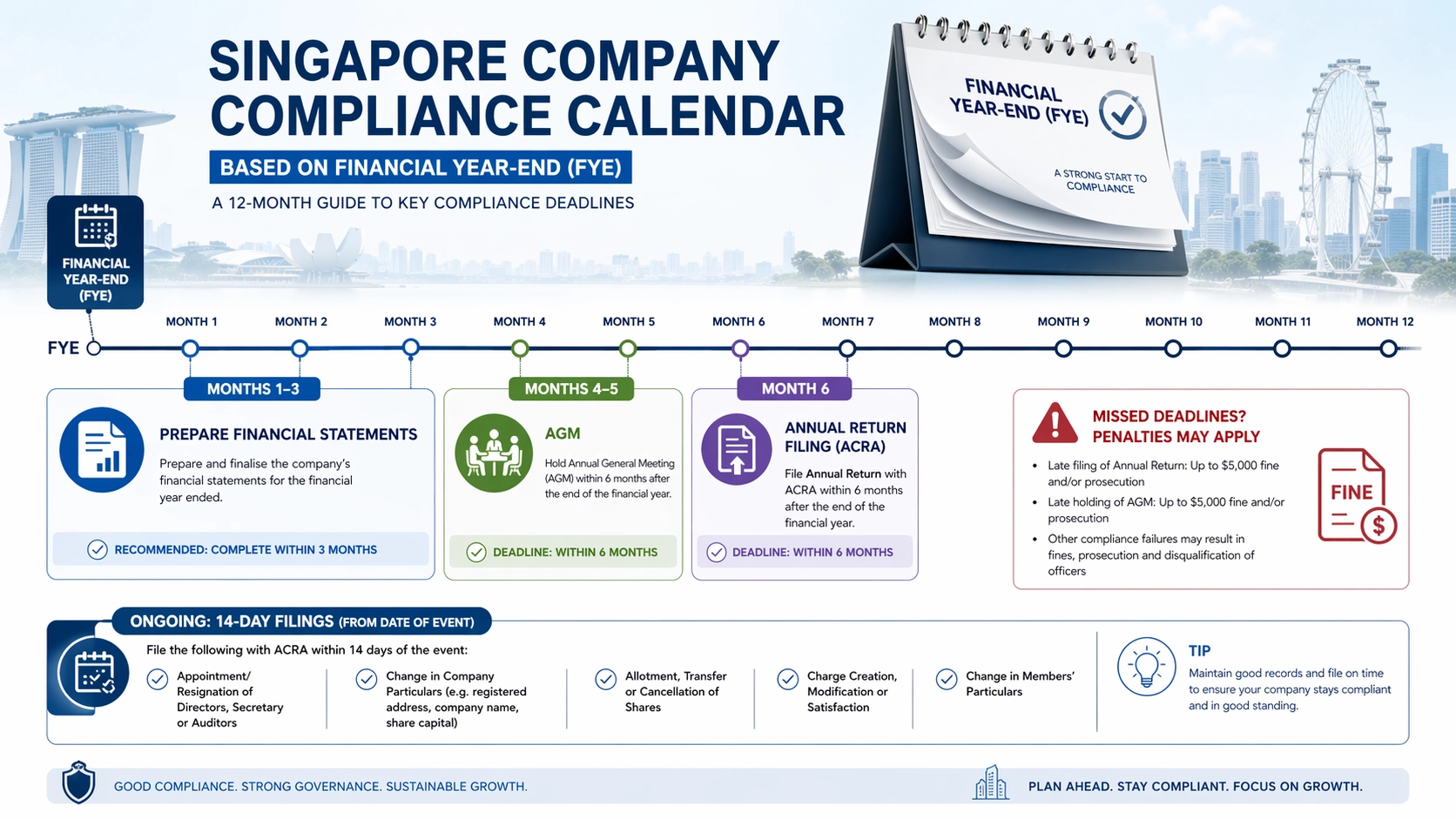
Singapore company directors operate within a well-defined regulatory framework. The Accounting and Corporate Regulatory Authority sets clear expectations for timely filings. Fail to meet them, and penalties begin at SGD 300. Directors who repeatedly fall short may face personal liability. In extreme cases, ACRA removes the company from the register entirely.
The encouraging reality is that compliance is not a labyrinth. It is a structured timeline. Your financial year-end determines every date that follows. Once established, the path is entirely predictable. This guide is your practical roadmap. Circulate it among your leadership team. Build your internal procedures around it. Let us walk through each phase of the year.
Establish Your Financial Year-End as the Anchor
The financial year-end (FYE) marks the close of your company’s accounting period. December 31 is the most common choice across Singapore, though you retain the freedom to select any date that serves your business.
This date is the cornerstone of your compliance architecture. Every filing deadline extends forward from it. Ensure your finance personnel, board members, and external advisors all have it clearly documented. If you later need to change your FYE, ACRA requires formal notification. For planning purposes, regard it as fixed and immovable.
The Active Phase: Months 1 to 6 After FYE
The first six months following your books’ closure demand your concentrated attention. The majority of statutory obligations fall within this period.
Months 1 Through 3: Prepare Your Financial Statements
Begin immediately. Collect all accounting records. Reconcile every bank account against your ledgers. Finalize your profit and loss statement, balance sheet, and all accompanying notes. If your company requires a statutory audit, appoint your auditors at once. Even those exempt from audit must still produce financial statements for shareholder review.
Last-minute preparation invites errors. Errors require correction. Correction delays your AGM, which compresses your Annual Return timeline. Build adequate lead time into your schedule from the very beginning.
Months 4 to 5: Hold Your Annual General Meeting
Private companies must convene an AGM within six months of their FYE. Shareholders review the financial statements. The board may propose dividends. Directors may stand for re-election depending on your articles.
Your company secretary services provider orchestrates the logistics. They draft the meeting notice, prepare the resolutions, and record the formal minutes. These documents form part of your permanent statutory record. Store them securely.
If all shareholders consent in writing, you may bypass the physical meeting entirely. Written resolutions are faster and carry identical legal weight. Your corporate secretarial services advisor ensures the documentation meets all formal requirements, whether passed at a meeting or by written means.
Month 6: File Your Annual Return
This is your most significant filing obligation. Within one month after your AGM, you must submit your Annual Return via ACRA’s BizFile+ platform. The return includes your financial highlights, current director details, shareholder information, and registered office address.
Timely filing costs SGD 60. Late submissions trigger penalties starting at SGD 300, increasing with delay. Directors risk personal liability for habitual non-compliance. This deadline demands your full respect.
Many directors find that engaging professional company secretarial services Singapore transforms this filing from a source of stress into a smooth administrative process. A capable provider verifies accuracy, assembles documentation, and submits with comfortable margin.
The Steady Phase: Months 7 to 12 After FYE
With the Annual Return filed, intensity subsides. But governance attention must not disappear.
Use this period to update your statutory registers. Did you issue new shares? Appoint a director? Change your registered address? Each change must be recorded internally and reported to ACRA within the required timeframe.
Address any overdue updates from earlier in the year. Late notifications attract their own penalties. Staying current is far simpler than catching up later.
This is also the right time to review your compliance systems. Are your records organized? Is your support team responsive? Have you set reminders for the next cycle? Small improvements now prevent future problems.
The Two-Week Rule: Ongoing Filing Requirements
Some corporate changes do not wait for the AGM cycle. They trigger immediate reporting duties.
Consider these examples:
- A new director joins the board: file within 14 days
- A director resigns: file within 14 days
- Your registered address changes: file within 14 days
- Shares are issued or transferred: file within 14 days
- Your company changes its name: file within 14 days
ACRA’s systems automatically flag late submissions. Each violation carries its own penalty. When multiple changes occur, file each one separately and promptly. Do not batch them into a delayed submission.
Your corporate secretarial services partner should track these changes as they happen. But directors remain legally responsible. Request filing confirmations. Review status reports. Never assume delegation equals completion.
Why Professional Support Is Worthwhile
Managing this calendar while running a business is genuinely difficult. Your focus belongs on customers, products, and growth. Compliance is essential, but it is not your primary expertise.
This is where company secretary services add real value. A qualified provider keeps your calendar under constant watch. They draft resolutions. They execute filings. They alert you before deadlines arrive. You lead your business with confidence rather than worry.
The company secretary role goes beyond paperwork. This professional maintains your statutory registers, ensures your AGM and Annual Return meet all standards, and advises on governance matters. Outsourcing to professional corporate secretarial services gives you expert support without the cost of a full-time hire.
Growth is another factor. As your company expands, adds subsidiaries, or enters new markets, compliance becomes more complex. A good provider scales with you. No need to find new vendors. You simply adjust your engagement to match your evolving needs.
Practical Habits for Staying on Track
Build these practices into your routine.
Set calendar alerts immediately after your FYE closes. Mark your AGM deadline and Annual Return due date. Add at least two weeks of buffer time for preparation.
Enable ACRA BizFile+ alerts. Keep your contact details current. Ensure official emails are not caught in spam filters.
Maintain a compliance folder. Keep resolutions, minutes, and filing receipts in one place. Digital storage is fine, provided it is organized and backed up.
Communicate with your team. Align your finance lead on financial statement timelines. Secure early board agreement on AGM dates.
Review your advisors annually. Are they proactive? Do they explain things clearly? If performance slips, consider a change. Reliability matters more than the lowest price.
Quick Reference: December 31 FYE
For companies with a December 31 year-end:
- January–March: Finalize financial statements
- April–May: Hold AGM or pass written resolutions
- June: File Annual Return with ACRA
- All year: Report changes within 14 days
- July–December: Update registers, plan for next year
Shift these months to match your actual FYE. The sequence remains unchanged.
Closing Thoughts
Compliance will never be exciting. But it keeps your company legally sound. It protects you from penalties. It builds trust with banks, investors, and partners.
You do not need to know every regulation by heart. You need a system. Know your FYE. Understand your deadlines. Use professional company secretary services where you need help. Set reminders. Stay organized.
If the burden feels too heavy, reputable corporate secretarial services can lighten the load. They bring structure to complexity. They ensure you meet every obligation. They free you to focus on what you do best.
Build good habits now. The benefits compound year after year. Your future self will thank you.

Comments
No comments yet. Be the first to react!